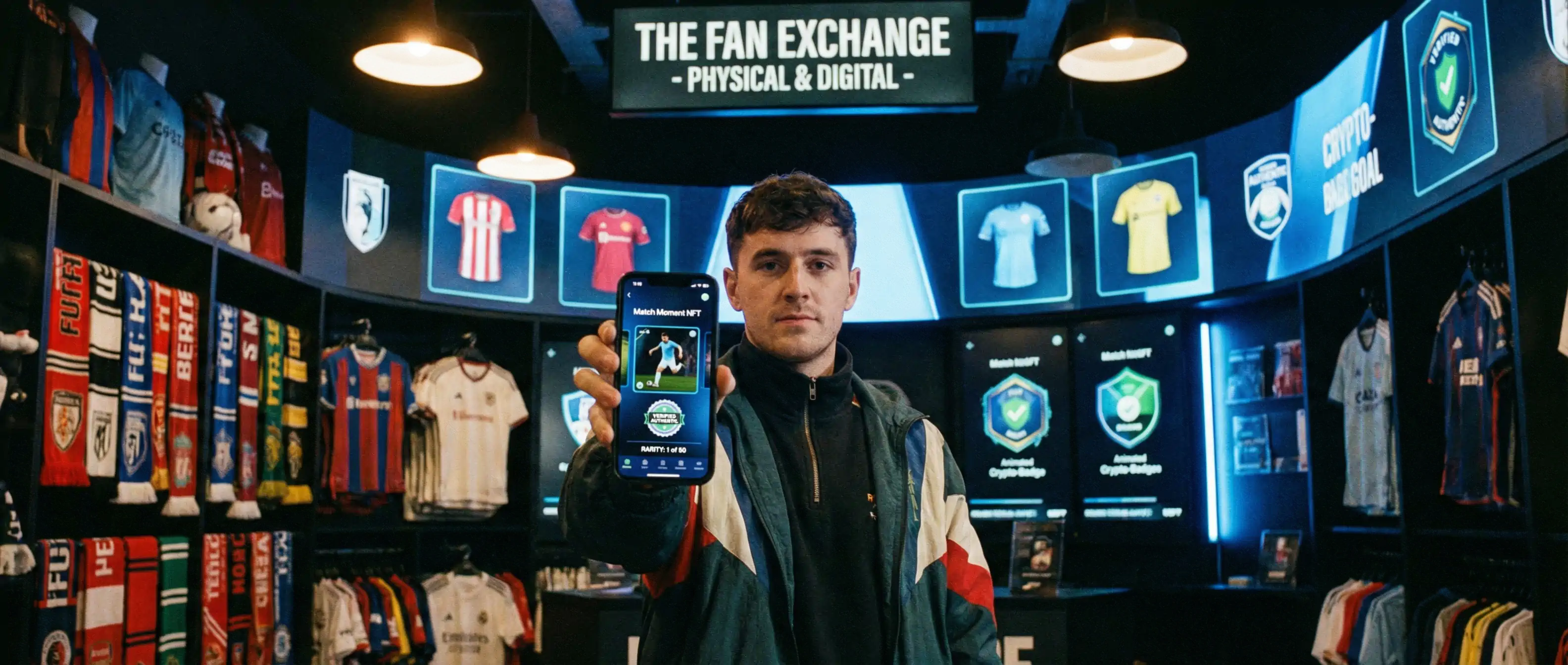
Ask ten clubs what matchday revenue means and you'll get ten different spreadsheets. Some count tickets only. Some fold in concessions and merchandise. Almost none of them count the fans who never made it through the gate, even though that's most fans, most weeks, for most clubs.
We build Game Set Engage, a fan engagement platform, and the question we hear most from club owners isn't "how do I get more engagement." It's "does engagement actually turn into money, and if so, where." This is our honest answer.
Matchday revenue is everything a club earns directly around a fixture: ticket sales, food and drink, merchandise, hospitality, and sponsor activation. Clubs running venue partnerships can add a further stream: partnership fees from local businesses where fans check in to watch, whether or not they made it to the ground. US readers often call this game-day revenue.
What counts as matchday revenue?
The core of it is unglamorous: tickets and season memberships, concessions, merchandise sold at or around the fixture, hospitality packages, and whatever sponsor activation is tied specifically to that game. That's the definition most finance teams work from, and it's a real category of money. Across Europe's top clubs, matchday revenue hit a record €2.4 billion in 2024/25 and grew faster than any other revenue line for the fourth year running, according to Deloitte's Football Money League. Those are elite-club numbers, not a benchmark for a community club, but they show the category is worth taking seriously at every level.
For a club running venue partnerships through a platform like ours, there's a fourth stream worth naming separately: the partnership fees local businesses pay for the fans they get to see. It isn't ticket revenue and it isn't sponsorship. It's its own line, and it's the one we'll spend the most time on below, because it's the one that's actually measurable in cash rather than inferred.
Why doesn't fan engagement automatically increase revenue?
Because engagement is a metric, not a transaction. A leaderboard nobody acts on, a push notification nobody opens, a points balance nobody redeems: none of that pays for anything on its own. Engagement becomes revenue only when it changes what a fan does. Someone shows up who wouldn't have. Someone brings a friend. Someone watches at a partner venue instead of alone at home. A sponsor sees proof that's worth paying for.
That distinction matters because most fan engagement reporting stops at the metric. Participation is up, great, but participation in what, leading to what? If you can't trace a specific engagement action to a specific behaviour change, you're measuring attention, not revenue. Second-screen use backs this up from the other direction: 82% of in-person attendees now use a mobile app during live events, and 91% of that group engage with it during the event itself, most often for real-time commentary and stats, according to a 2025 IBM study. Fans are already reaching for their phones at your fixture. The question is whether anything on the other end of that phone moves money.
How do you get more fans through the gate?
You reward showing up, and you reward it more than showing up somewhere else or not at all. On Game Set Engage, a club sets its own point values for an event check-in campaign across three independent tiers: the stadium, a partner venue, and home. Nothing is hardcoded. Our recommended multiplier flow, and it's only an example configuration, is five points for checking in at the ground, three at a partner venue, and one at home. A club can set the home tier to zero if it doesn't want to reward the couch yet; turn it off, and a check-in attempted outside the venue radius simply gets refused.
Every check-in is GPS-verified in the app, no QR code and no hardware needed for the primary flow, within a radius the club sets per campaign, about 100 metres by default. That's a floor for trust more than a growth lever on its own: the growth comes from what you build on top of it, campaigns that run across a season rather than one fixture. Repeat attendance is genuinely trackable this way. A club can see its unique versus repeat participants campaign by campaign, so "did the same fans come back for the next home game" stops being a guess. We don't offer attendance streaks, because we haven't built anything that rewards a fan for a specific run of consecutive games; what we measure instead is whether the same person shows up again, which is the number that actually correlates with matchday revenue. If you want the deeper case for why live-fixture attention is worth building for on its own terms, we've written separately about engaging fans during live broadcasts.
Setup for one of these campaigns takes about 15 minutes, and it's published to your subscribed fans the moment you finish, no review queue sitting between you and a fixture that's already on the calendar; check-in itself opens an hour before the event starts and closes half an hour after it ends. Every campaign needs both a start and an end date; there's no such thing as an open-ended one.
Can fans who don't attend matches still generate matchday revenue?
Yes, and this is the lever that's actually worth building around, because it's the only one we can point to a confirmed transaction for. A local business, anywhere in the world, registers on Game Set Engage for free, submits its Google Maps listing, gets approved, and requests a partnership with your club. There's no distance limit on who can apply. A pub in London can partner with a club its diaspora supporters grew up following in another country just as easily as the café next to the ground can.
Once a venue is live on one of your check-in campaigns, it sets its own incentive on top of yours, 20% off the tab, a free coffee, whatever fits the counter, and once the venue's staff confirm the fan's 10-minute check-in QR, the fan earns your club's points on top of the venue's deal. The fan's location is verified against the venue's, so the redemption is tied to someone actually being there. Each confirmed check-in or offer claim accrues a fee, at the amount you set, that the venue owes your club. The venue pays a gross monthly invoice, our tiered commission comes out of your club's share rather than being added on top, and the rest settles to you monthly. On our own modelled numbers, a club with around 5,000 fans, five partner venues, and roughly 30% of fans active can earn somewhere in the region of $2,580 a month this way. That's an illustrative scenario, the same one on our revenue-growth page, not a promise, because it depends entirely on how many venues sign up and how many fans actually check in. Venues never pay a subscription to be listed; the fee only exists where a check-in actually happened.

This is the part worth being blunt about: most of what we describe as matchday revenue is inferred, tickets sold because a campaign ran, merchandise bought because a fan was more engaged that week. Venue partnership fees aren't inferred. A check-in either happened and was billed, or it didn't. If you want the fuller case for why this is worth building deliberately rather than treating as a side feature, we've laid it out in our revenue growth features.
How does fan engagement help clubs land sponsors?
The honest version of this is that your next sponsor is probably already sitting in your stands. Season ticket holders who own local businesses are a far easier sell than a cold outreach deck, and it's a case we've made in more detail in Your Next Sponsor Is Already in Your Stands. What engagement data changes is the conversation you have with them. Instead of guessing at reach, you can show a business the fans who watched at their venue and were rewarded for showing up there, plus the venue's own deal claimed on top.
What Game Set Engage doesn't do is put that data in a sponsor's hands directly. There's no sponsor login, no dashboard, no exportable ROI report. What the club gets is verified engagement data it presents to the sponsor itself, off-platform, in whatever format that conversation calls for. Sponsorship money doesn't run through the platform either; it's a relationship between the club and the business, settled however they agree. What we're good for is giving the club something more concrete than a season ticket count to bring into that meeting.
Which matchday revenue claims should you be sceptical of?
Any platform, including ours, that claims to measure ticket, concession, or merchandise uplift in dollars is guessing unless it's actually integrated with your point-of-sale or ticketing system. Game Set Engage isn't a ticketing system and doesn't connect to POS, CRM, or ticketing software today. We can show you that a campaign ran and that participation and repeat attendance moved. We can't tell you that a specific fan bought a jersey because of it, because we never see that transaction. Be wary of any vendor who tells you otherwise without a POS or ticketing integration to back it up.
The one exception, deliberately, is venue partnerships: that's a fee we bill and a payment the venue makes, so it's the one number on this list we can state as cash rather than correlation. Everything else, tickets sold, food and drink spent, merchandise moved, is an outcome the club drives using engagement as one of its tools, not a number any single engagement platform can hand you with confidence. When you're evaluating platforms, ask lever by lever: where does the money actually move, and who's confirming it moved? If a vendor can't answer that for a specific feature, assume the number is modelled, not measured. We've written a fuller comparison of what a dedicated platform covers against a patchwork of separate tools in Fan Engagement Stack vs. Single Platform, and a broader survey of monetisation approaches in Sports Fan Monetization Strategies if you want the wider picture beyond matchday.
What we do cover in one place is check-ins, campaigns, points, venue offers, push notifications, and analytics. We don't do email marketing directly, but a club can export any fan segment as a CSV and run its own campaign through whatever email tool it already uses (Fan Segments are on the City plan and above).
Getting started
The fastest way to see whether any of this moves your matchday numbers is to run it: set up an event check-in campaign for your next home fixture, approve one venue partner, and watch whether the same fans show up twice. Game Set Engage's Local plan is free for up to 1,000 active fans, no card required, with every core feature included; premium features like the naim AI Assistant and Fan Segments unlock on paid plans. See the full pricing breakdown if your fan base is bigger than that.
Frequently asked questions
What is matchday revenue?
Matchday revenue is the money a sports club earns directly around a fixture: ticket and season membership sales, food and drink, merchandise, hospitality packages, and sponsor activation tied to that game. Clubs running venue partnerships can add partnership fees from local businesses where fans check in to watch as a further stream. US clubs often use the term game-day revenue for the same thing.
How does fan engagement increase matchday revenue?
Engagement only becomes revenue when it changes a fan's behaviour: they attend when they otherwise wouldn't have, bring someone with them, watch at a partner venue instead of at home, or give a sponsor proof worth paying for. Rewarding those specific actions with points, and tracking whether the same fans return, is what connects engagement to money rather than just attention.
Can fans who don't attend matches still generate revenue for the club?
Yes. Fans who watch at a partnered local venue can be rewarded for checking in there, and that venue pays the club a fee for each confirmed check-in or offer claim. It's the one revenue stream tied directly to a fixture that doesn't require a fan to be physically at the ground.
How do partner venues pay the club?
A venue that partners with a club sets its own incentive on a check-in campaign, and each confirmed check-in or offer claim accrues a fee. The venue pays a gross monthly invoice; the platform's commission comes out of the club's share of that amount, and the remainder settles to the club monthly.
Do points cost the club money?
No. Points are the club's own currency inside the platform: fans bid them in auctions, spend them to unlock deal codes, and build a lifetime leaderboard total that never resets each season. They don't represent a cash liability to the club. The only cash that changes hands is the venue partnership fee, which is billed separately from points.