Two things you're billed for
Your account with a club accrues charges from two separate events, and they're billed differently. Getting this distinction right is the difference between an invoice that makes sense and one that surprises you.
Check-ins. A fan checks in at your venue and someone on your team confirms it. That's one fee. If the same fan checks in again the same day, you're not charged twice — one fan, one venue, one day, one fee.
Offer redemptions. A fan claims one of your offers and you confirm it. That's a fee too, and this one has no same-day cap. If the same fan redeems twice today and you confirm both, that's two fees.
The reasoning is straightforward: a redemption is a sale. If a fan came in twice and you served them twice, the platform sent you two pieces of business, so it books two fees. A check-in is just a signal that someone showed up, and someone can only show up once in an evening.
Which means the setting below is the one that actually moves your bill.
The setting that decides your bill
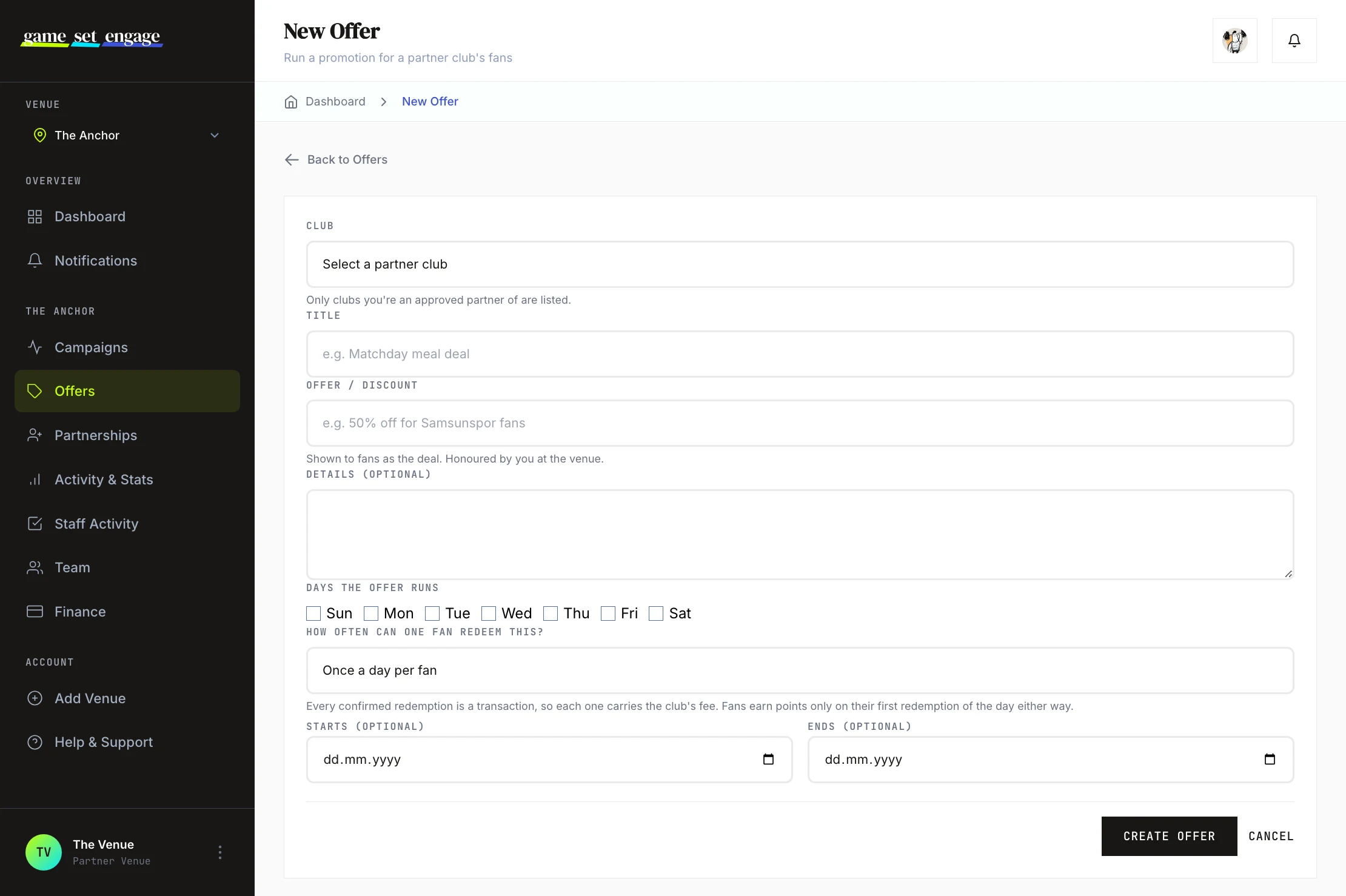
On your own offer form there's a field: "How often can one fan redeem this?" You set it, not the club.
- Once a day per fan (the default) — a fan can redeem this offer once per day. A second attempt the same day is refused before it reaches you: "You've already claimed this offer today." One fee.
- Every visit (repeat redemptions) — every redemption is allowed, and every confirmed one carries a fee.
Pick every visit deliberately. It's the right choice for something like a matchday drinks deal where repeat orders are the whole point, and the wrong one for a "20% off your tab" offer you only meant a customer to use once.
One catch worth knowing before you pick every visit
The fee and the fan's reward don't follow the same rule. You're charged for every confirmed redemption, but a fan only earns points on their first one each day.
So on an every visit offer, a customer's second redemption today costs you a fee and gives them nothing extra in points. They still get the discount — that's what they came for — but if you chose every visit expecting the points to keep motivating repeat orders, they won't.
If you're unsure, leave it on once a day per fan. You can change it later, and the change applies to new redemptions.
What you control, and what the club controls
It's worth being clear about the split, because it explains why some numbers aren't yours to change.
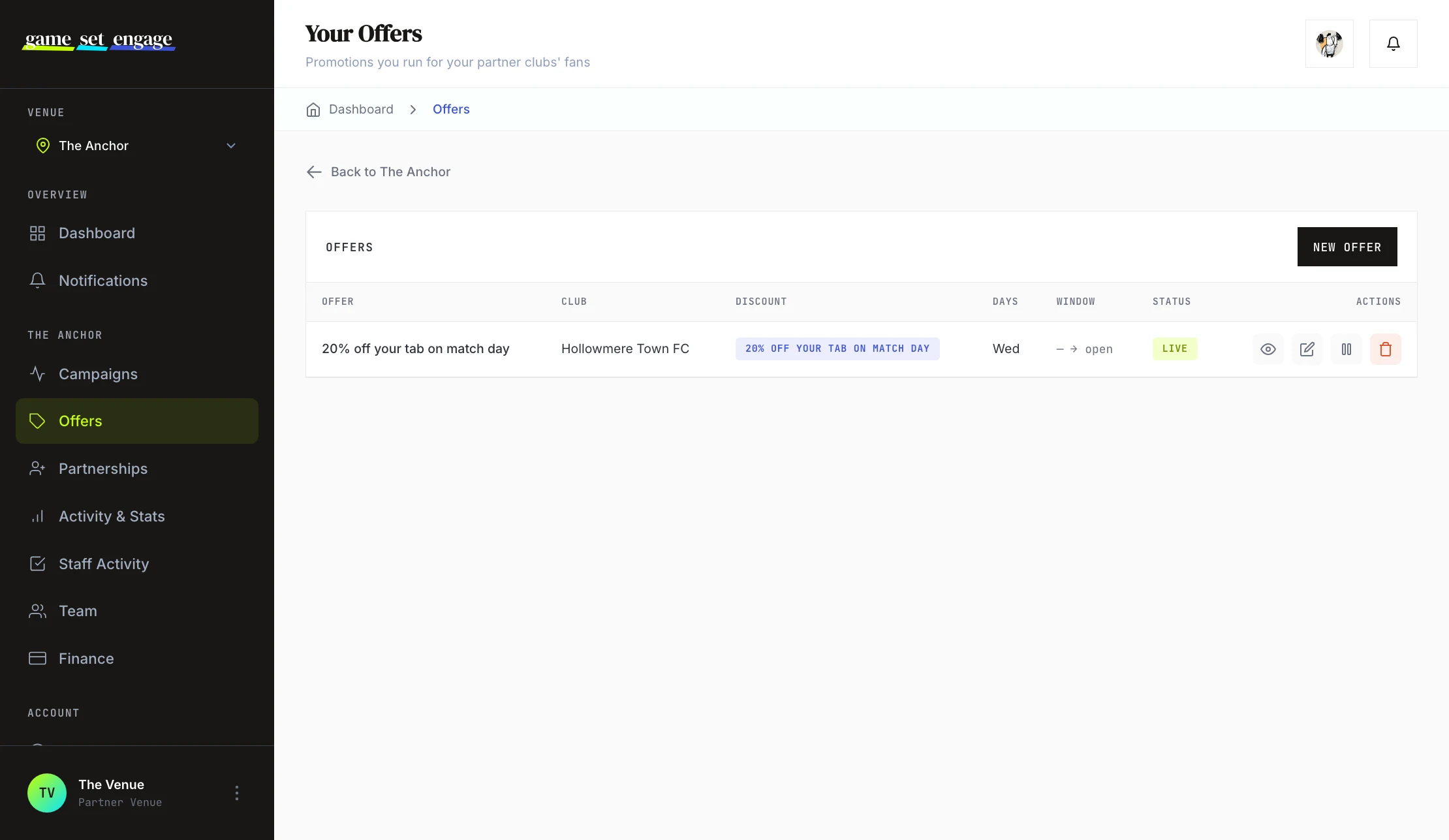
You set: the offer itself — what it is, the days it runs, and how often one fan can redeem it.
The club sets: the fee you pay per redemption, how many points the fan earns, and whether redemptions need approval. You'll see the fee on your offer; you just don't set it.
That's the deal underneath the partnership. You're buying footfall at a price the club sets, and you decide what you're offering and how often someone can take it.
A partnership can end from either side: the venue's owner or a manager can end it from the dashboard, and so can the club's team. When it ends, your offers for that club's fans stop. Redemptions you've already confirmed, the fees they booked, and your invoices stay as they are, and you can ask the club to partner again later, unless it has stopped accepting your requests.
Redemptions that never reach you
Like check-ins, some claims are refused on the fan's phone. Nothing is created, so there's nothing to approve and nothing to pay.
Too far away. A fan has to be within 100 metres of your venue with location switched on. Outside that: "You appear to be too far from this venue to claim this offer." With location off: "Location is required to claim an offer at a venue." Location is required on every claim and checked against your venue's coordinates.
Already claimed today, if your offer is set to once daily.
Your venue isn't active — your venue is active from sign-up, so this only happens if Game Set Engage has suspended it or taken it off the platform.
One difference from check-ins worth knowing: offers belong to you, not to a club campaign. So a fan who is locked out of a club's campaign can still redeem your offer. Campaign rules don't reach your offers.
You can't confirm your own claim
Same rule as check-ins. If you redeem your own offer using your personal fan account, someone else at the venue has to confirm it. The system compares the account that opened the claim against the account approving it, and refuses when they match.
Everything else is fine — you can confirm any customer's claim on your own, with nobody else on shift.
The invoice
On the 1st of each month you get one invoice covering everything from the previous month. Not one per club — one invoice, with each club's charges itemized separately, so you can see where the total came from. You pay it online by card. If it's still unpaid after its due date, your venue is paused for fans and new business until it's paid, then picks up again by itself: When your venue is paused has the details.
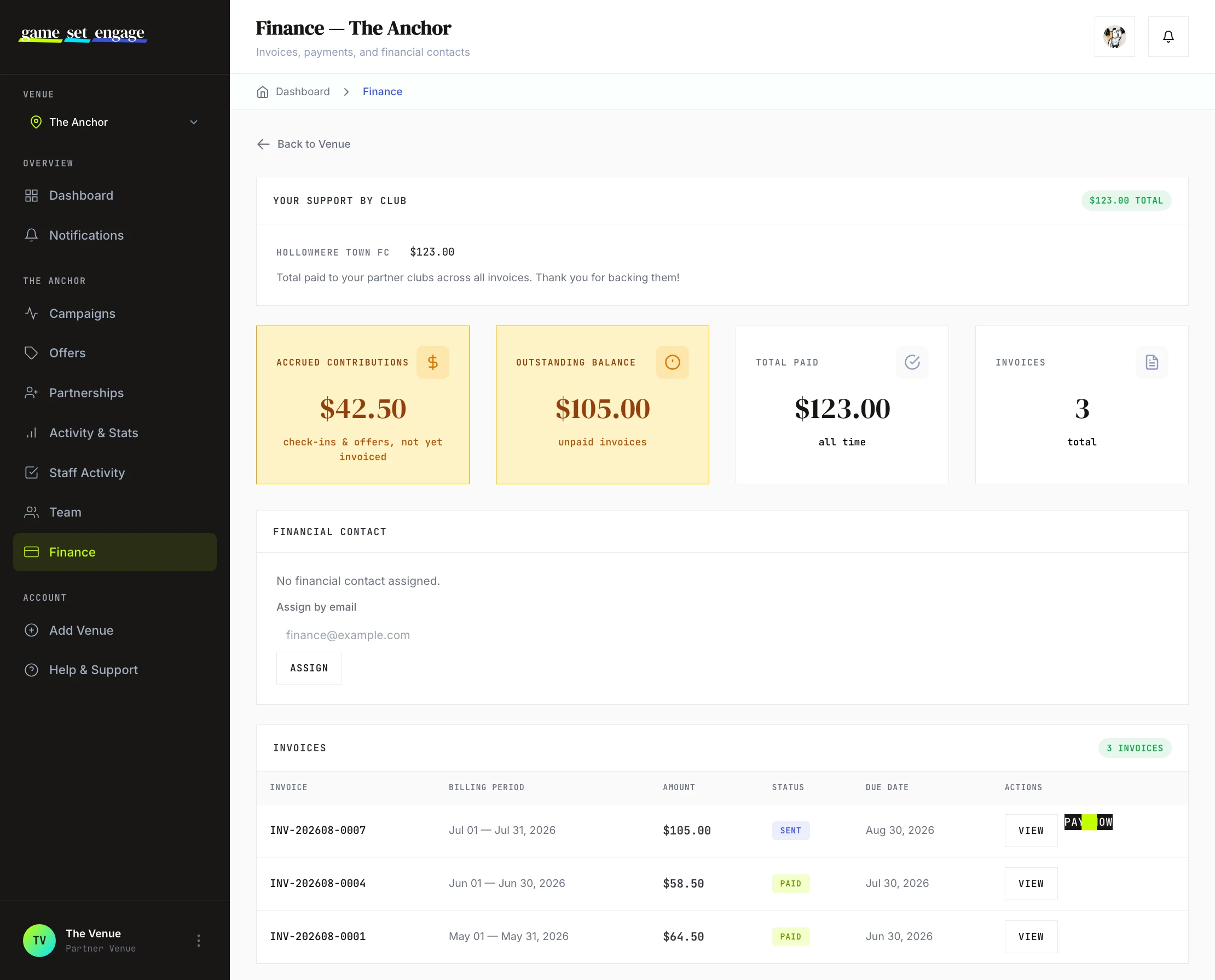
Every line traces back to a confirmed check-in or redemption, and every confirmation carries the name of the person on your team who approved it. If you ever want to query a charge, that trail is what answers it. Worth keeping in mind when you hand approval rights to someone.
The commission arrangement between Game Set Engage and the club doesn't involve you. You owe the club its fee; how that gets split afterwards is their side of the ledger.
Keeping the bill predictable
Three habits keep the month boring, which is what you want from a bill:
- Set the redemption limit before you launch the offer, not after you see the first invoice.
- Decide who confirms. Every approval is a charge, so approval rights are spending rights.
- Turn off offers you're not running. A live offer with no intention behind it is still redeemable, and still billable.
What's next
- Approving check-ins at your venue — the flow behind the other half of your bill
- Venue earnings and offer settings — the club-side view, including the fees they set